Learnings from across the field
At a time when businesses and industries are increasingly interconnected, relying on a single field of expertise can sometimes limit growth or, in this specific case, the adoption of additive manufacturing (AM).
Although the technology’s capabilities are no longer to be proven, this healthcare edition of 3D ADEPT Mag reminds us that 3D printing remains one small technology solution amid the vast array that healthcare systems must assess and adopt every day.
When you consider that hundreds of reports are published annually across medical device, diagnostic, and digital health categories, predominantly driven by high-risk medical devices (MD) and in vitro diagnostics (IVD) in Europe, it becomes understandable that AM and 3D printing are rarely at the top of health economists’ agendas.
And yet, when you know that there are not a lot of technologies capable of disrupting a wide range of fields well beyond healthcare (like AM/3D printing does), you begin to understand the passion and enthusiasm of those who champion it.
That said, passion alone does not save lives, nor make a business profitable. It is one driver among many.
This healthcare edition of 3D ADEPT Mag has, for the first time, brought together a health economist, a clinician, and a convener. Together, they discuss the barriers and explore solutions faced by AM companies and technology providers, hospitals, clinicians, point-of-care labs, HTA bodies and payers, as well as policymakers, and how each of them must show up to make progress possible.
This is probably one of the longest dossiers we have ever produced. It is also likely one of the most important.
Beyond the dossier itself, the learnings gathered across this edition come not only from different disciplines converging to share their perspectives, but also from the lived experiences of healthcare professionals around the world, from Asia to the Americas.
Taken together, this edition makes a case that is both urgent and hopeful: that global health security and additive manufacturing are more intertwined than they may appear, and that the technology’s greatest contribution may ultimately be measured not in parts produced, but in lives improved.
Exclusive features
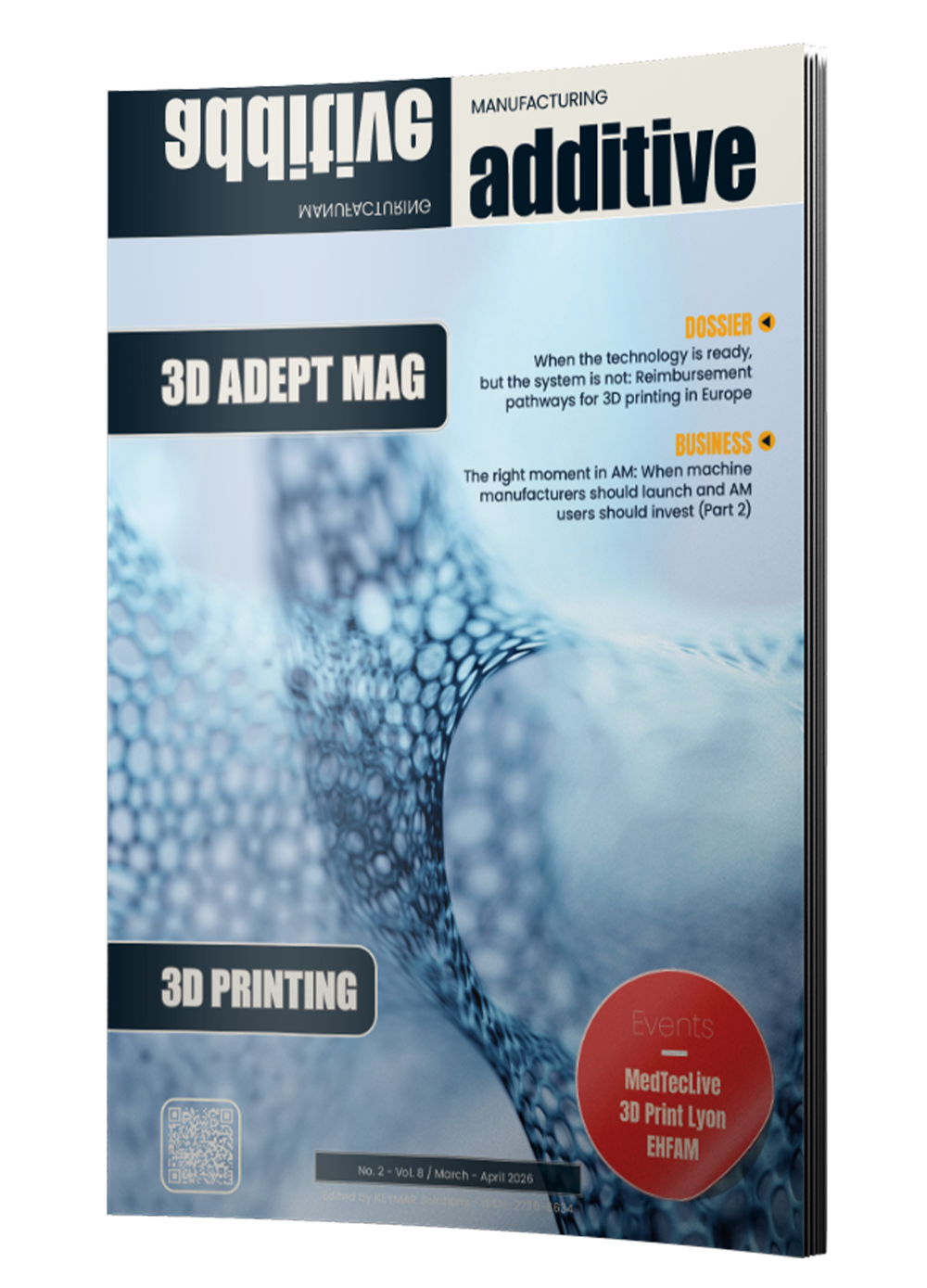
Dossier | When the technology is ready, but the system is not: Reimbursement pathways for 3D printing in Europe
In a previous dossier, we explored the current state of public policies that help patients benefit from 3D-printed implants, mapping a landscape of national fragmentation, regulatory uncertainty, and missed connections between innovators and payers. What we found, above all, was a technology maturing faster than the frameworks designed to absorb it but also, countries working in silos to get 3D printing approved by healthcare systems. This dossier picks up where that conversation left off and goes deeper.
With contributions from Kinga Meszaros, Health economics and policy professional, Laura Cercenelli, biomedical engineer and senior staff at eDIMES Lab, a university hospital 3D point-of-care lab, and Naomi Nathan, Head of Medical, Medical Goes Additive (MgA).
Business | The right moment in AM: When machine manufacturers should launch and AM users should invest (Part 2)
In Part 1 of this dossier, featured in the January/February edition of 3D ADEPT Mag (pp. 13–16), we explored three foundational questions:
- Whether current innovation is truly driven by user needs or if it risks becoming innovation for innovation’s sake
- How dif ferent technologies generate different signals and why those triggers vary by role
- The lifecycle of industrial AM equipment and what manufacturers should evaluate before investing
This second part shifts the focus to two intertwined themes: modular platforms and timing, how to determine when innovation creates value, and when it introduces risk.
AM Shapers | Virtual surgical planning at scale: How SGH built a point-of-care AM program that works
This conversation with Dr. Mark Tan, Radiologist and Clinical Lead of the Singapore General Hospital (SGH) 3D Printing Centre, explores the impact of Virtual Surgical Planning and Clinical 3D Printing (VSP-C3DP) at SGH, and more importantly, the workflow, quality standards, and operational maturity that make that impact possible.
AM For Nonprofits | 1,200 solutions, zero patents: TOM’s 3D printing model for accessible assistive technology
In this Q&A series, Gidi Grinstein, Founder & President of Tikkun Olam Makers (TOM), shares with 3D ADEPT Media how TOM’s model works in practice, from design methodology and manufacturing choices to quality control, cross-border iteration, and what it would take for the advanced manufacturing industry to engage more deeply with the humanitarian potential of additive manufacturing.
Opinion | Why Silicone 3D printing still struggles to find its place in healthcare
When you know that other 3D printing technologies have found a natural place in implants, medical devices sold at scale, in the everyday toolkit of a clinician or hospital, it’s quite paradoxical to realize that the sector that seems like the natural home of silicone additive manufacturing is the one where adoption has remained most cautious. This opinion piece offers the opportunity to unpack why and to take stock of who is building the ecosystem capable of changing it.
News RoundUp: Healthcare 3D printing, closer to the patient than ever
Since the beginning of 2026, 3D printing continues to move from proof-of-concept to embedded clinical practice. We have been reporting on a convergence of better tools, bolder hospital decisions, and increasingly credible applications. Across dental prosthetics, craniofacial surgery, pharmaceutical compounding, orthopaedics, and audiology, additive manufacturing continues to showcase its capabilities on how care is delivered.
Subscribe to download the 2026 March/April edition of 3D ADEPT Mag
"*" indicates required fields